Voice
A raw thought can enter without first becoming a polished prompt.
PRODUCT / AI / UX / 2026
Independent prototypeFrom scattered intentions to daily action.
Illustrative request: “I want to start a project, but I am not sure I can handle the scope.” The same example continues through the analysis and decision map below.
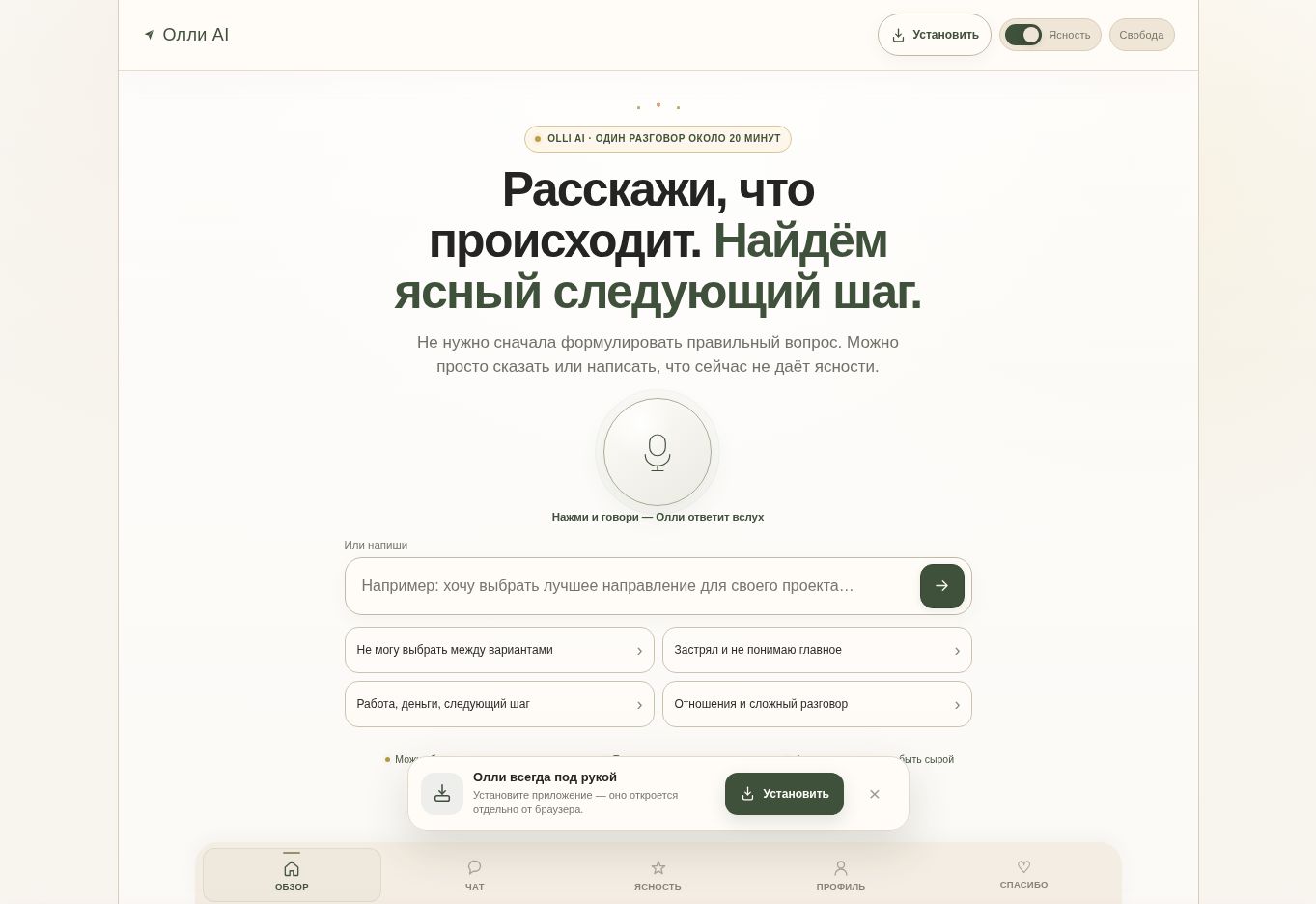
A raw thought can enter without first becoming a polished prompt.
The interface asks for the situation, not for technical parameters.
Examples reduce the blank-page barrier without predetermining the answer.
Two routes are compared: commit to a large scope immediately, or test one narrow scenario first.
In this illustrative example, two evenings a week are available for the project.
The current commitments need to remain stable while the idea is tested.
The time required for a useful first version is still unknown.
Build one narrow scenario, record the actual time and revise the route if it does not fit.
The product screenshot is a real capture. The decision-card panel is an explanatory reconstruction of the implemented data and prompt logic, clearly separated from the live screen.
A person describes a situation in everyday language. The system separates facts from assumptions, connects them to values and criteria, compares options and returns a structured decision map instead of generic advice.
Open request and clarifying questions
Facts, values and unknowns
Options, risks and criteria
Conclusion and reversible first step
Simplified system view — the purpose is to explain the logic, not imitate a deployment diagram.
The core innovation is not the chat window. It is the controlled loop between a live conversation, structured memory, a decision artifact and feedback from reality.
The current message is weighted more strongly than old context. A router selects only the relevant decision, safety or voice capability.
Conversation memory, confirmed meanings and evidence are assembled into a compact working context — not an unlimited personal dossier.
The model separates what is known from what is assumed, compares routes and produces a structured decision card instead of generic advice.
The person confirms, edits or rejects the interpretation. New evidence changes the map and makes the next answer more precise.
The map keeps the source, confidence and evidence count. Repeated evidence may strengthen an item, but the person’s explicit confirmation remains decisive.
A new observation starts as a hypothesis. Confidence grows only when independent conversations support it.
The person can confirm, edit, resolve or reject an item. The system does not silently turn an inference into a fact.
Sensitive patterns are phrased as possibilities; diagnostic language is filtered from generated map items.
Immediate danger, medical urgency and self-harm signals bypass the ordinary answer and receive a dedicated safety response.
Facts, criteria, unknowns and the next step remain visible and can be revised separately.
The conversation needs extra clarification before it can produce a useful map.
Product concept, decision logic, UX and implementation direction.
Decision map, conversation flow and prototype interface.
AI assistants, advisory systems and decision-support interfaces.
Have a similar task or an idea to explore?
DISCUSS A TASK →