See it in a story
A short episode gives the phrase a situation, intention and emotional cue.
EDTECH / CONTENT / UX / 2026
Evolving prototypeShort connected episodes make useful vocabulary return naturally.
English Flow removes the boundary between reading and practice. A phrase first appears where it means something, then becomes an object that can be heard, saved and recalled later.
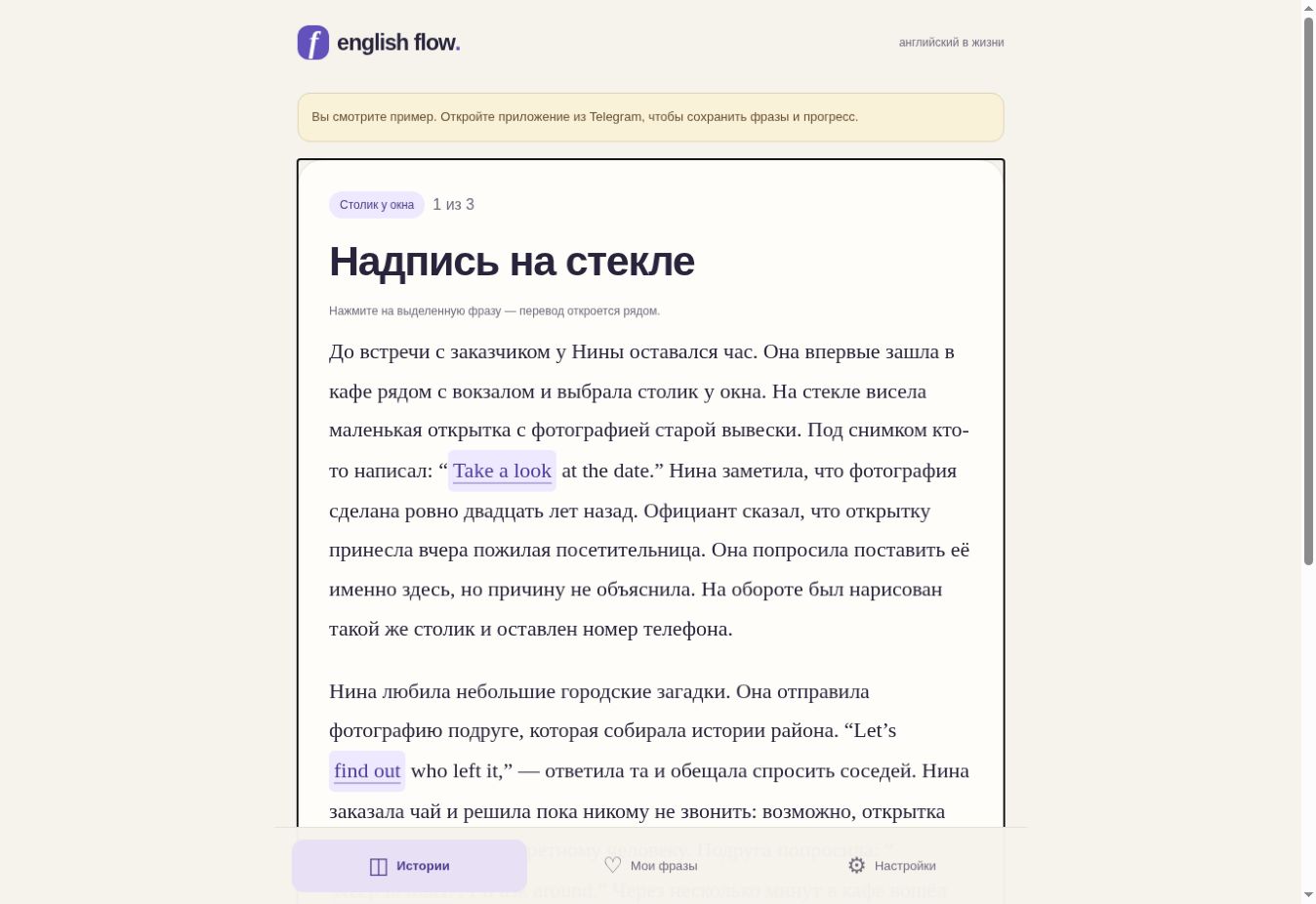

A short episode gives the phrase a situation, intention and emotional cue.
The phrase card explains meaning and shows intended speech controls; the screenshot alone does not verify audio playback.
The product direction is to bring the phrase back in another scene. A real later episode is still required as public evidence.
Why: meaning is easier to reconstruct from a situation than from an isolated vocabulary card.
Trade-off: translation and speech controls can interrupt reading, so the interface must make the return to the story immediate.
The proposed system separates content delivery, story access, phrase state and the moment of return. Repository-level implementation details should be published only after their current state is verified.
A short episode introduces vocabulary inside a clear scene. The system remembers the key words, brings them back in later stories and saves the continuation point, making learning feel like a series rather than isolated exercises.
A short scene with new context
Links between words and examples
Repetition in a new situation
Progress and continuation point
Simplified system view — the purpose is to explain the logic, not imitate a deployment diagram.
Learning format, product mechanics, UX and implementation direction.
Connected micro-episodes, vocabulary recurrence and a continuation flow.
Adaptive learning systems and connected content mechanics.
Have a learning product idea to explore?
DISCUSS A TASK →